Since the adjustment of net tax rates as of 01.01.2025, more than two rates are legally permitted. However, this requires manual intermediate steps in bexio, as the system automatically supports only two net tax rate digits. Affected users whose rates have changed or who now require a third net tax rate must filter the relevant turnover via the journal and calculate the tax manually instead of relying on the automated form. The values determined this way are then manually added to the FTA (ESTV) portal for declaration; in bexio, auxiliary tax keys without assigned box numbers should often be used for this purpose.
Content
Initial Situation
Important information regarding the 2025 VAT revision – Handling changed net tax rates and their accounting in bexio:
As of January 1, 2025, the partial revision of the VAT Ordinance (MWSTV) has come into effect. This brings significant changes, especially for users of the net tax rate method, such as the expansion to up to ten simultaneously applicable net tax rates (previously a maximum of two).
We recommend reviewing this support article together with your fiduciary/accountant. Certain VAT postings may need to be adjusted retrospectively.
Since the Federal Tax Administration (FTA / ESTV) also adjusted certain net tax rates at the beginning of the year, we would like to point out two central challenges when using the net tax rate method in bexio:
1. Expansion to more than two net tax rates:
bexio currently only supports the previous regulation with a maximum of two net tax rates (digits 323 and 333).
2. Adjustment of existing net tax rates:
It is possible that your applicable net tax rate was changed as of 01.01.2025 and you may not have noticed this.
Are you affected?
First, check your accounting method via the following link:
«Settings» - «All Settings» - «Accounting» - «VAT Basic Settings»
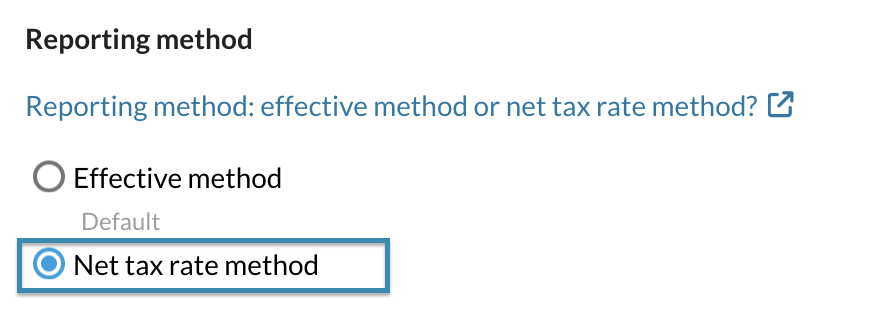
If you do not account using the net tax rate method, this topic does not affect you.
I use "NET TAX RATES" and account based on "COLLECTED" amounts
In the following chapters, you will learn more about the procedure in various scenarios.
I use "NET TAX RATES" and account based on "COLLECTED"
You can check your accounting type and method via the following path: «Settings» - «All Settings» - «Accounting» - «VAT Basic Settings».
You have Net Tax Rate accounting and account based on collected amounts . (Your settings are the same as in the following illustration.)
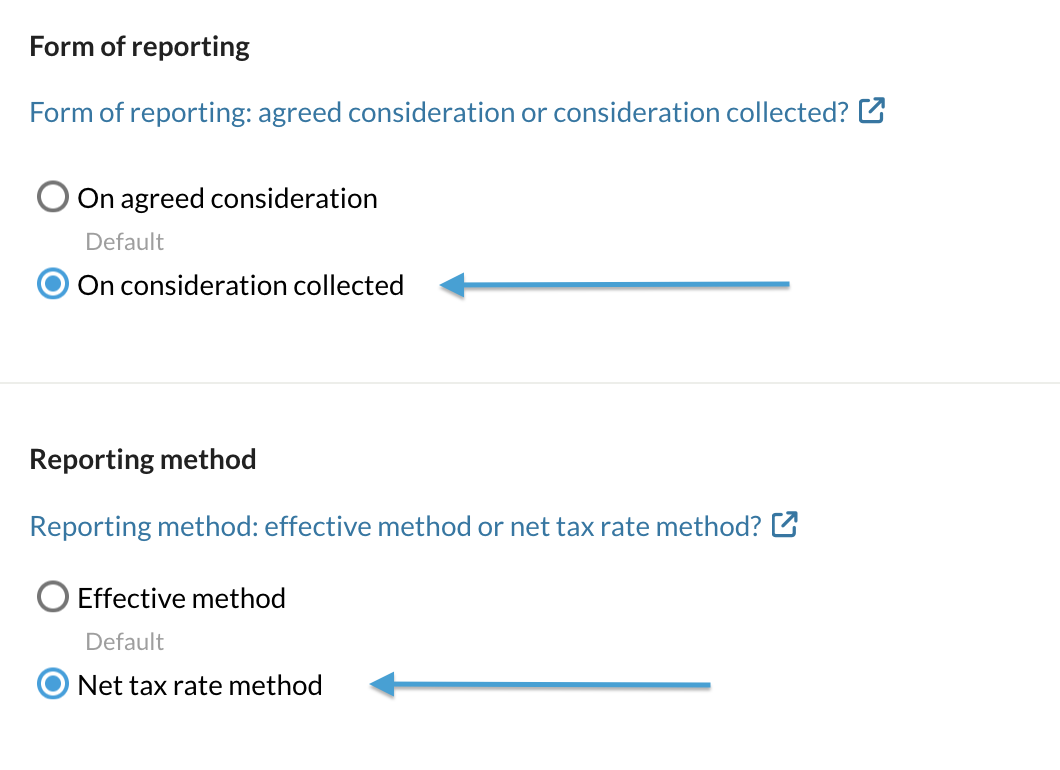
Continue and check the following points for the scenario that applies to your situation.
My previous net tax rate has changed - I have only one net tax rate
My previous net tax rate has changed for 2025. I have already used the old rate in invoices/postings in 2025. What should I do?
In this case, we recommend continuing to account with the old net tax rate for 2025. Create a new net tax rate and only start using it as of January 2026.
Do not set an end date for the old rate. As long as you have open invoices up to 2025, no end date may be set, as VAT only becomes due upon payment.
You can find out how to create a new net tax rate in the following article: Creating a net tax rate.
Below you can see an example illustration with an old rate and a new rate from 2026.
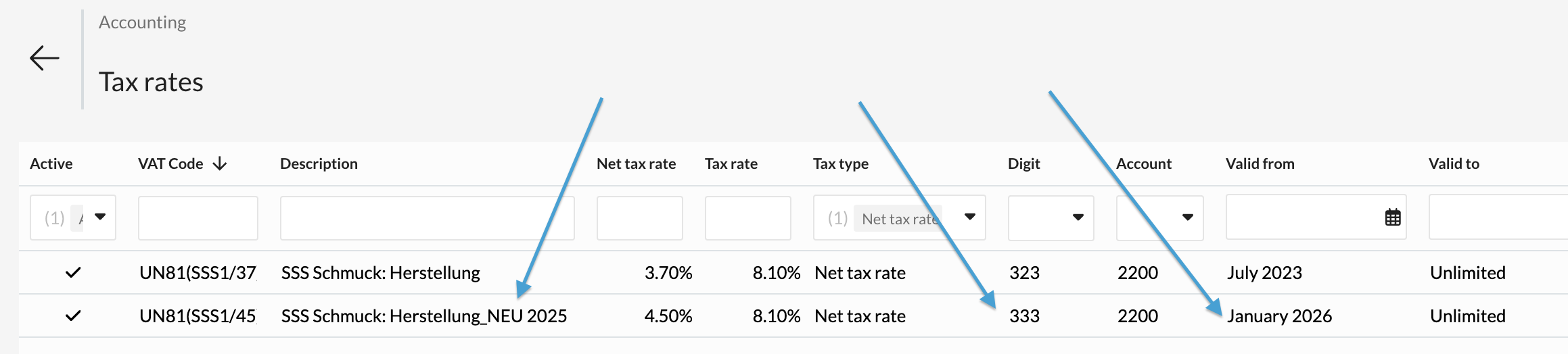
Since the incorrect net tax rate will still be applied in 2025, the VAT to be paid must now be calculated manually.
Manual calculation of turnover and VAT to be paid
Step 1: Open the Journal
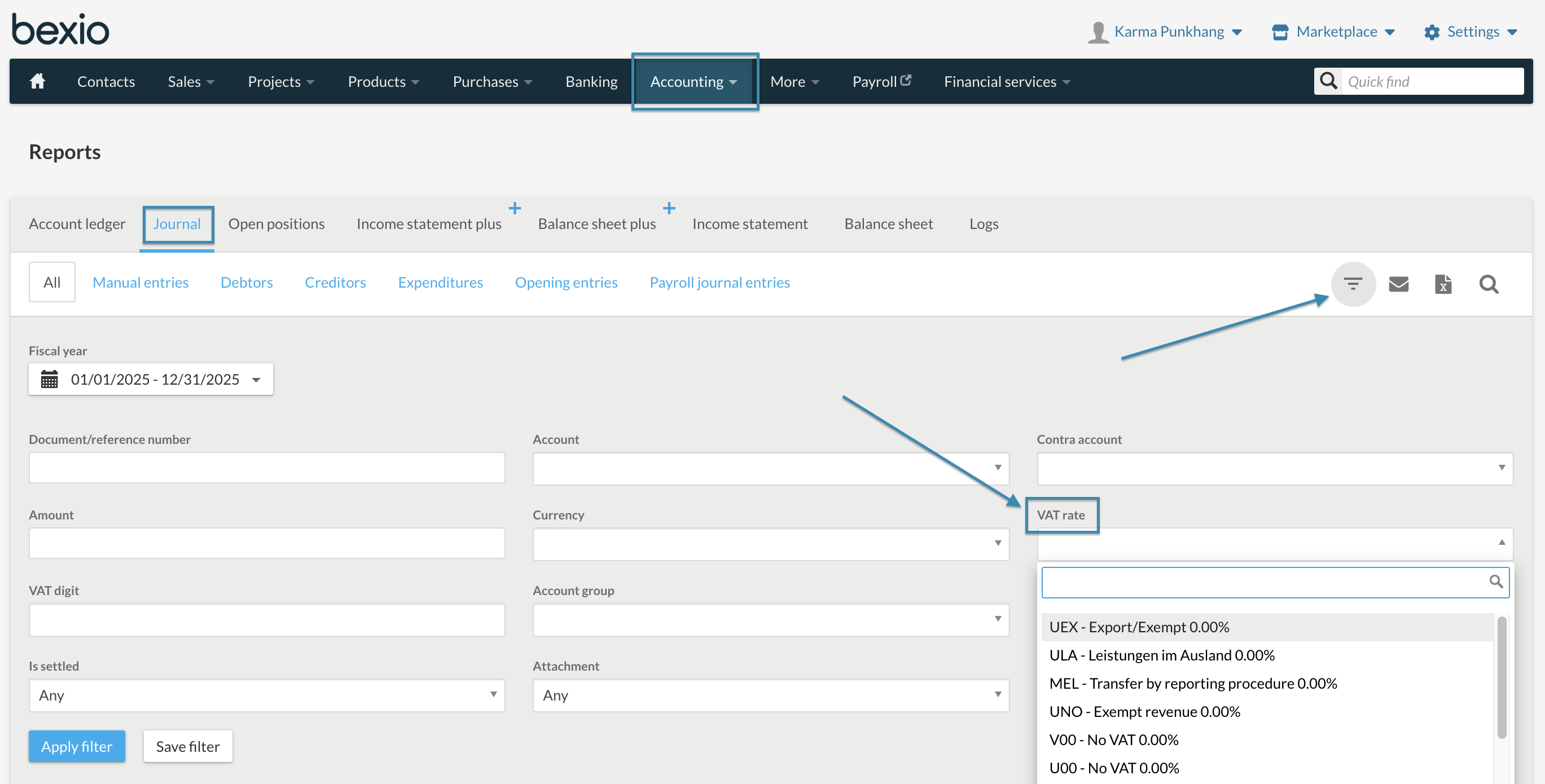
- Navigate to «Accounting» -> «Reports» -> «Journal».
Step 2: Filter by VAT code
- Click on the filter icon (top right) for detailed search.
- Set period: Set the date for the accounting period you want to declare (e.g., 1st or 2nd semester 2025).
- Filter by VAT rate: In the filter field "VAT rate", select your old net tax rate.
- Apply the filter.
Step 3: Determine and export turnover
The journal will now show all postings created in the selected period with your old net tax rate.
Determine total turnover: Add the total amounts from the Debit or Credit column of the revenue account. This corresponds to the taxable total turnover (incl. VAT) for this specific net tax rate.
Formula: Total Credit - Total Debit = taxable total turnover
Tip: For easier processing, you can download the filtered journal via the export function as an Excel or CSV file. You will find the button at the top right next to the filter button.
Step 4: Manually calculate tax amount and enter in the ePortal
Calculate tax amount: Multiply the determined total turnover (from Step 3) by the new net tax rate.
Formula: Total turnover x Net tax rate in % / 100
Declaration:
Open the VAT form in the FTA (ESTV) ePortal and declare the turnover and tax amount as usual.
My previous net tax rate has changed - I have two or more net tax rates
My previous net tax rate has changed for 2025. I have already used the old rate in invoices/postings in 2025. What should I do?
In this case, we recommend continuing to account with the old net tax rate for 2025. Create a new net tax rate and use it starting January 2026.
Do not set an end date for the old rate. As long as you have open invoices up to 2025, no end date may be set, as VAT only becomes due upon payment.
You can find out how to create a new net tax rate in the following article: Creating a net tax rate.
Below you can see an example illustration of how these tax rates could look.
For the old 1st net tax rate, digit 323 is stored; for the 2nd rate, digit 333 is stored; and for the new 1st net tax rate, no digit is stored.
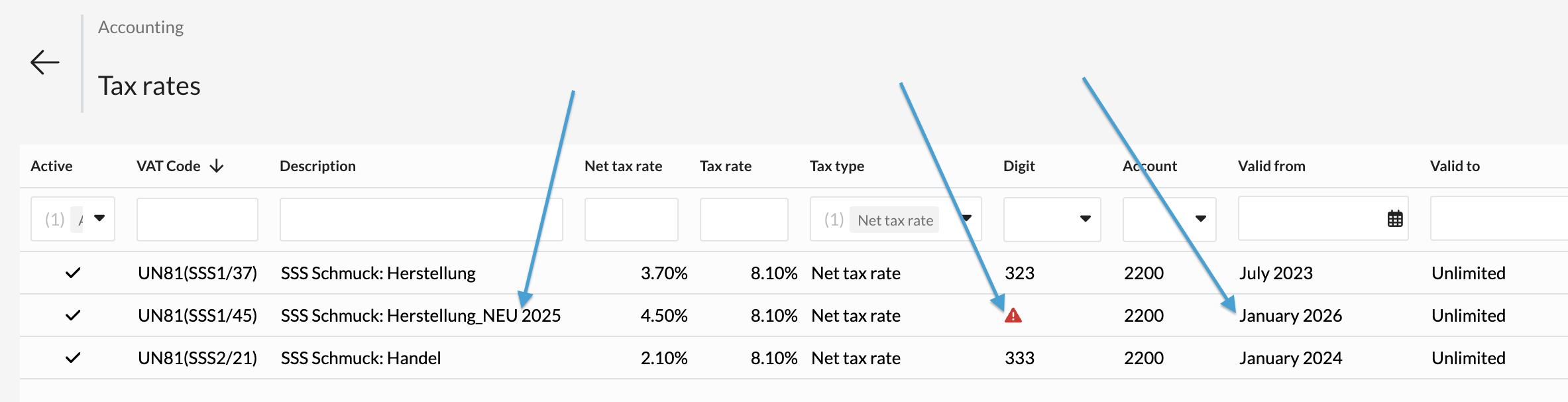
Since the incorrect 1st net tax rate is still being applied to digit 323 in 2025, the VAT to be paid must now be calculated manually. Your 2nd net tax rate is not affected and does not need to be calculated manually.
Manual calculation of turnover and VAT to be paid
Step 1: Open the Journal
- Navigate to «Accounting» -> «Reports» -> «Journal».
Step 2: Filter by VAT code
- Click on the filter icon (top right) for detailed search.
- Set period: Set the date for the accounting period you want to declare (e.g., 1st or 2nd semester 2025).
- Filter by VAT rate: In the filter field "VAT rate", select your old net tax rate.
- Apply the filter.
Step 3: Determine and export turnover
The journal will now show all postings created in the selected period with your old net tax rate.
Determine total turnover: Add the total amounts from the Debit or Credit column of the revenue account. This corresponds to the taxable total turnover (incl. VAT) for this specific net tax rate.
Formula: Total Credit - Total Debit = taxable total turnover
Tip: For easier processing, you can download the filtered journal via the export function as an Excel or CSV file.
Step 4: Manually calculate tax amount and enter in the ePortal
Calculate tax amount: Multiply the determined total turnover (from Step 3) by the new net tax rate.
Formula: Total turnover x Net tax rate in % / 100
Declaration:
Open the VAT form in the FTA (ESTV) ePortal and declare the turnover and tax amount as usual.
I need to apply an additional, new net tax rate for 2025 - I previously had only one net tax rate
A secondary activity accounts for more than 10% of my total turnover. The FTA (ESTV) requires me to account for this turnover with a different net tax rate. I now have to account with two rates retroactively as of 01.01.2025. How do I proceed?
Create a new net tax rate and use it starting January 2026. You can find out how to create a new net tax rate in the following article: Creating a net tax rate.
Below you can see an example illustration of how these net tax rates could look (1x the old rate and 1x the new rate).
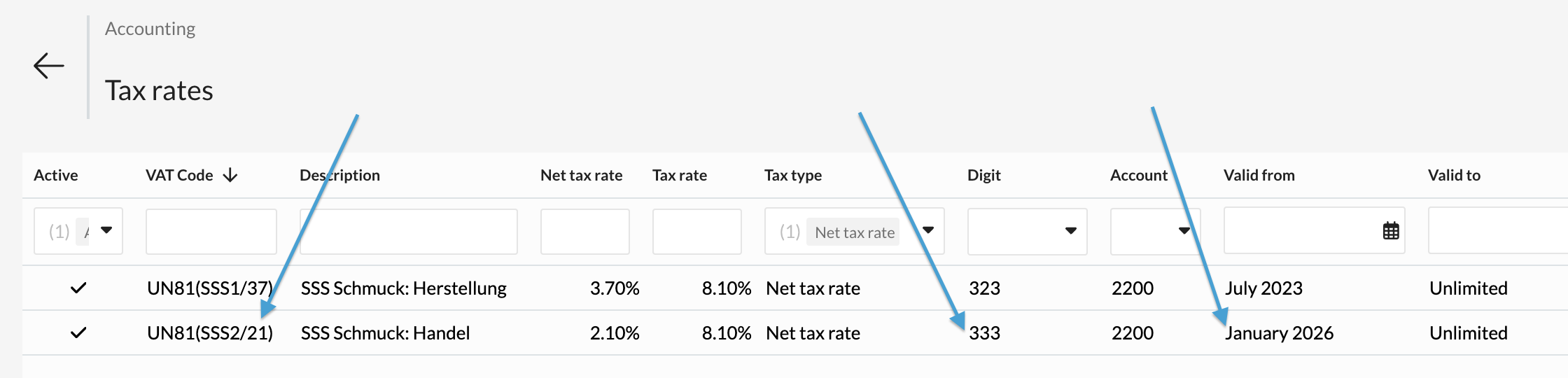
Since the incorrect net tax rate is applied to part of the turnover in 2025, the VAT to be paid must now be calculated manually.
Manual calculation of turnover and VAT to be paid
Step 1: Open the VAT form
- Navigate to «Accounting» -> «VAT» -> Select the period in the «Accounting period»
Step 2: Determine turnover
- Check which digit the 1st net tax rate is running on.
In the "Leistungen CHF" field, you see your turnover which, multiplied by the first net tax rate, shows the VAT to be paid. This value is incorrect. The turnover from the secondary activity must be deducted from the displayed turnover.
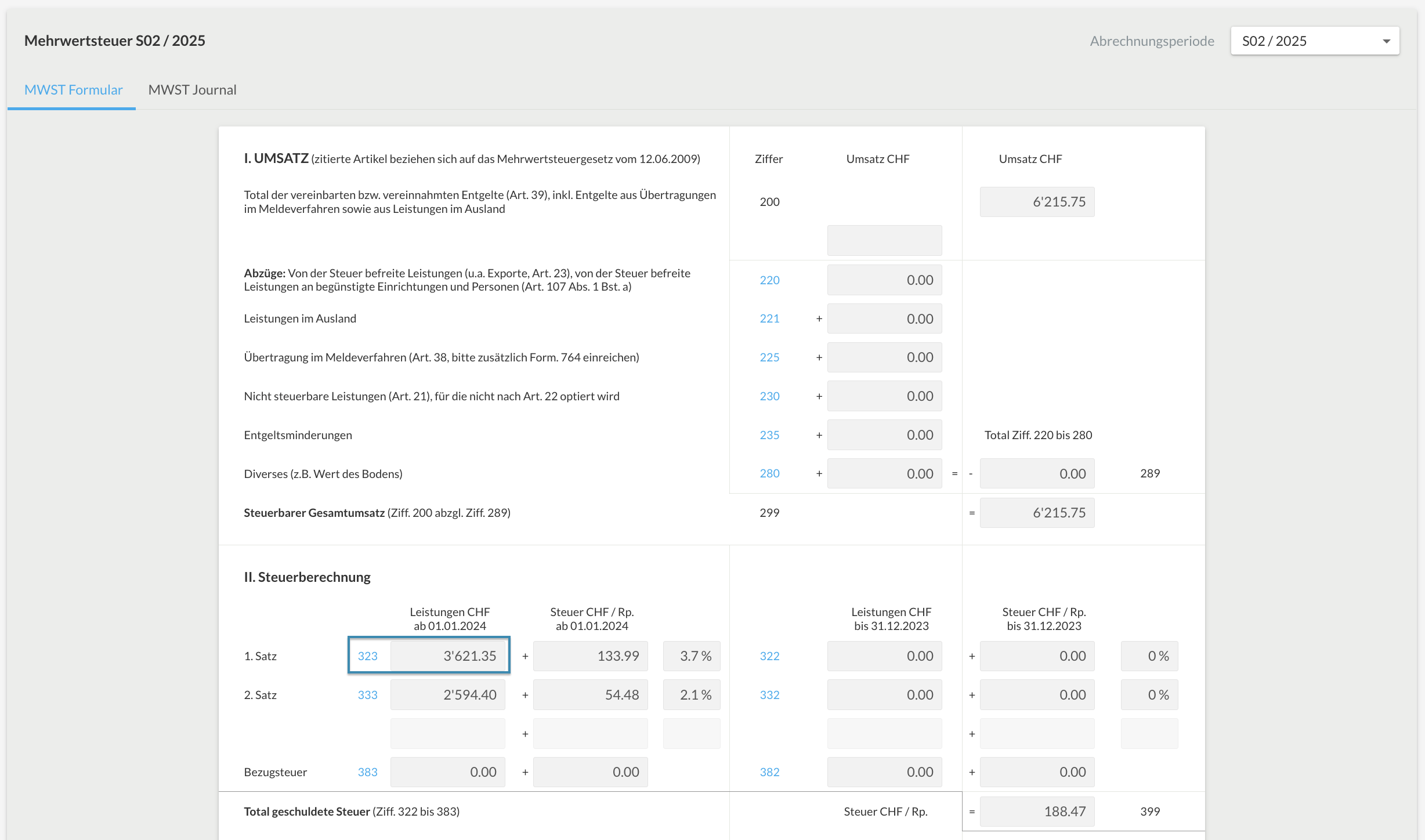
Step 3: Differentiate turnover (What is the turnover for the secondary activity?)
- Go to the VAT journal and filter by the corresponding digit. In this example, digit 323.
- Export to Excel and then filter by the revenue account for your secondary activity.
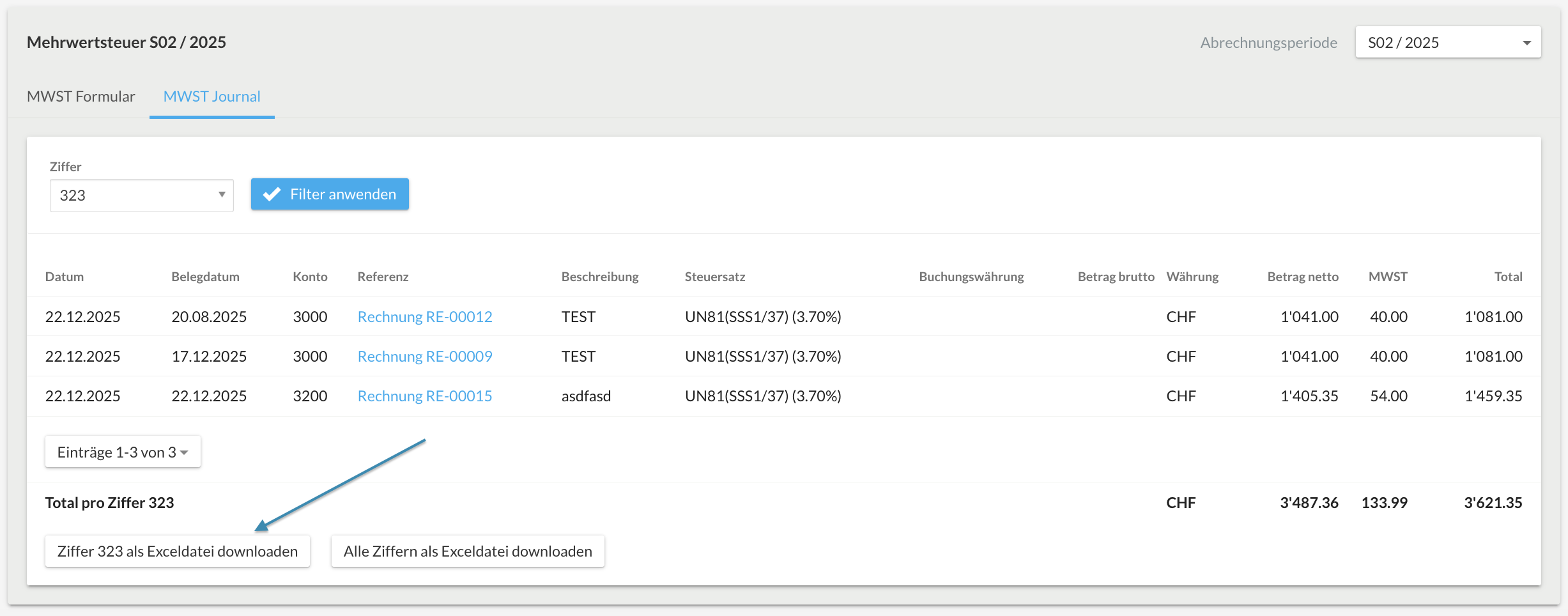
Calculate tax amount: Multiply the determined total turnover by the new net tax rate according to the FTA.
Formula: Total turnover x Net tax rate in % / 100
ATTENTION: If you have not previously maintained a separate revenue account and have posted everything to one revenue account, you must manually select and calculate these.
Declaration:
Open the VAT form in the FTA ePortal and declare the turnover and the tax amount as usual.
I need to apply an additional, new net tax rate for 2025 - I previously had two or more net tax rates
A secondary activity accounts for more than 10% of my total turnover. The FTA requires me to account for this turnover with a different net tax rate. I now have to account for three or more net tax rates retroactively as of 01.01.2025. How do I proceed?
In this case, we recommend continuing to account with the old net tax rate for 2025. Create a new net tax rate and use it starting January 2026. Do not assign a digit to this VAT code. You can find out how to create a new net tax rate in the following article: Creating a net tax rate.
Below you can see an example illustration of how these net tax rates could look. For the 1st net tax rate, digit 323 is stored; for the 2nd net tax rate, digit 333 is stored; and for the new 3rd net tax rate, no digit is stored.
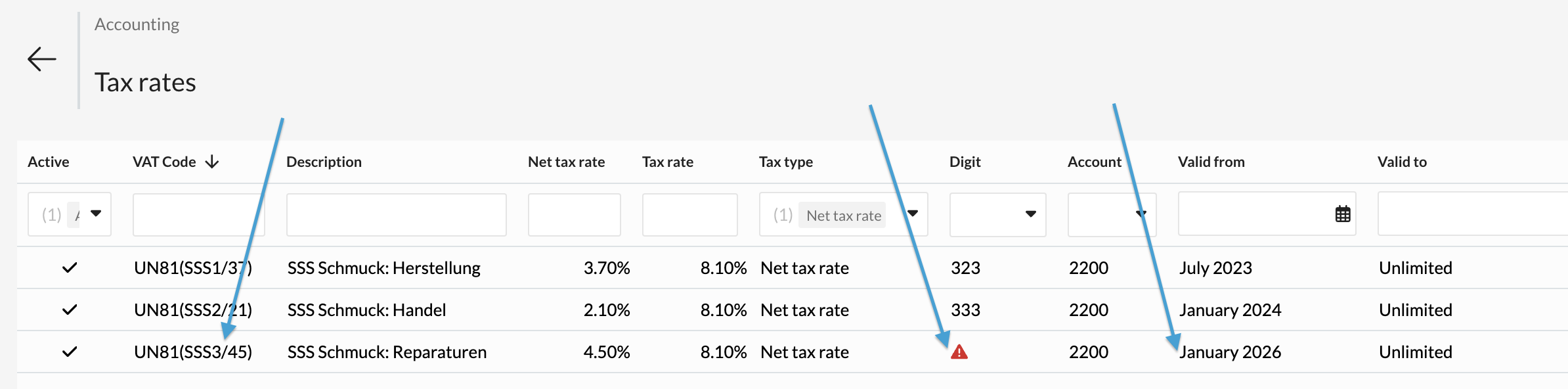
Since the incorrect net tax rate is still being applied in 2025, the VAT to be paid must now be calculated manually.
Manual calculation of turnover and VAT to be paid
Step 1: Open the VAT form
- Navigate to «Accounting» -> «VAT» -> Select the period in the «Accounting period»
Step 2: Determine turnover
- Check which digit the turnover for your new secondary activity has been recorded on.
In the "Leistungen CHF" field, you see your turnover which, multiplied by the net tax rate, shows the VAT to be paid. This value is incorrect. The turnover from the secondary activity must be deducted from the displayed turnover.
Step 3: Differentiate turnover (What is the turnover for the secondary activity?)
Calculate tax amount: Multiply the determined total turnover by the new net tax rate according to the FTA.
Formula: Total turnover x Net tax rate in % / 100
ATTENTION: If you have not previously maintained a separate revenue account and have posted everything to one revenue account, you must manually select and calculate these.
Declaration:
Open the VAT form in the FTA ePortal and declare the turnover and the tax amount as usual.